
My research spans a wide range of topics in theoretical physics of complex systems, including stochastic modeling of out-of-equilibrium systems, information dynamics on networks, and modeling dynamical systems with tensor networks. Below is a list of my current research projects. For a comprehensive list of published papers see Google Scholar. My past research in high-energy physics can be found on InSpire.
Selected research projects
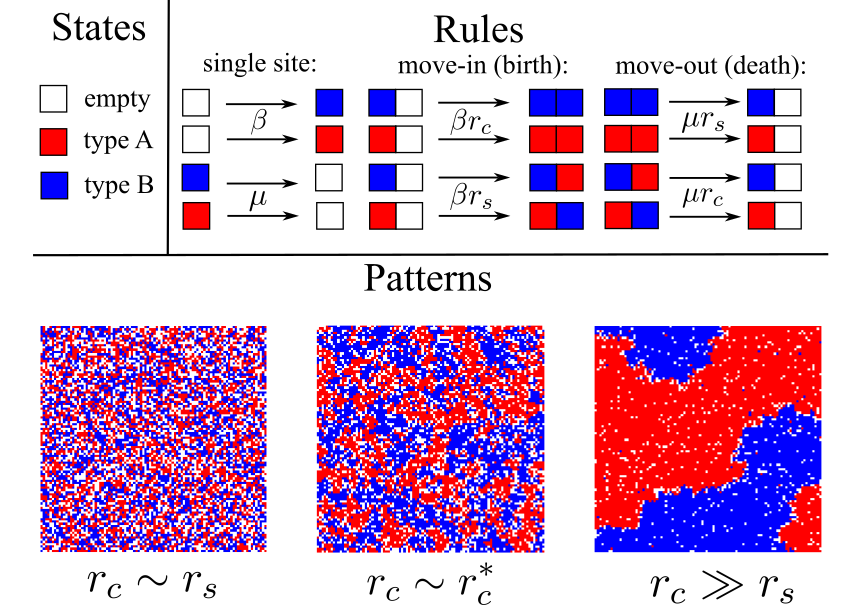
Stochastic reaction networks: from social tipping to a unified modeling toolkit
Many complex systems—cities, epidemics, ecological communities, chemical and biological systems—can be described in terms of random events that happen locally (moves, contacts, reactions) and collectively produce large-scale patterns. A useful way to formalize this is to treat the dynamics as a stochastic reaction–diffusion process: entities move in space, interact with each other, and change state at certain rates. This perspective is flexible enough to model social phenomena such as segregation and tipping points, while also connecting to a powerful mathematical toolbox originally developed in statistical physics and quantum many-body theory. In Field theories and quantum methods for stochastic reaction diffusion systems we review how quantum-inspired methods may be used to describe general stochastic reaction-diffusion systems. In Symmetric preferences, asymmetric outcomes, we propose an “open-city” segregation model where residential mobility is described through reaction rates rather than explicit utility optimization.
Publications relating to this research direction
- Field theories and quantum methods for stochastic reaction-diffusion systems
with Mauricio del Razo and Tommaso Lamma - Symmetric preferences, asymmetric outcomes: Tipping dynamics in an open-city segregation model with Fabio van Dissel and Tuan Minh Pham
Tensor networks for complex systems
Complex systems are hard to model because their full state is a high-dimensional probability distribution: in principle, the number of possible configurations grows exponentially with system size. In this project, I adapt tensor-network ideas—originally developed for quantum many-body physics—to build compact, controllable representations of these large probability distributions. The goal is to make it feasible to study correlations, rare events, and “near-critical” behavior in stochastic models where standard approximations can become unreliable.
One direction focuses on epidemic-style dynamics (SIS/contact process) on simple geometries, where tensor networks allow accurate access to the full distribution and to rare-event statistics without relying purely on Monte Carlo sampling. A second direction develops a tunable approximation scheme for spreading models on general networks: by increasing the tensor-network “bond dimension,” you can systematically trade computation for accuracy, quantify the effective complexity of the system (via entanglement-inspired measures). Lastly, we have used these entanglement-inspired measure of complexity to quantify the complexity of Wolfram’s cellular automata.
Publications related to this research project:
- Efficient simulations of epidemic models with tensor networks: application to the one-dimensional SIS model with Clélia de Mulatier and Philippe Corboz
- Effective dimensional reduction of complex systems based on tensor networks with Madelon Geurts, Clélia de Mulatier, and Philippe Corboz
- Operator Entanglement Growth Quantifies Complexity of Cellular Automata with Calvin Bakker


Information dynamics on networks
Many real-world systems—ranging from social contagion and opinion dynamics to epidemic spreading—are best understood as *information processing* on a network: local interactions can produce global behavior, often in ways that are not visible from node-level summaries alone. In this line of work, I develop and use a many-body, statistical-physics–inspired viewpoint to describe how information flows between configurations of a networked system, and how this reveals qualitative differences between widely used dynamical models. I also study the exact time evolution of simple spreading processes on networks, showing where commonly used mean-field approximations break down and how network substructures shape the dynamics.
Publications relating to this research project:
- Emergent information dynamics in many-body interconnected systems with Manlio De Domenico.
- Logistic growth on networks: exact solutions for the SI model with Ivano Lodato.
- Exact epidemic models from a tensor product formulation
Risk aversion can promote cooperation
Cooperation is essential in many biological and social systems, but standard models often assume individuals optimise long-term average payoff. In this work we explore a different, intuitive mechanism: individuals can be risk-averse, aiming to secure a minimum outcome with high confidence on a limited timescale. We show that this shift in decision-making can stabilize cooperative behavior and can create new stable outcomes in classic social-dilemma settings—offering a simple explanation for why cooperation can persist even when short-term incentives push the other way.
Risk aversion can promote cooperation with Jay Armas, Janusz Meylahn, Soroush Rafiee Rad, and Mauricio J. del Razo

Past research projects
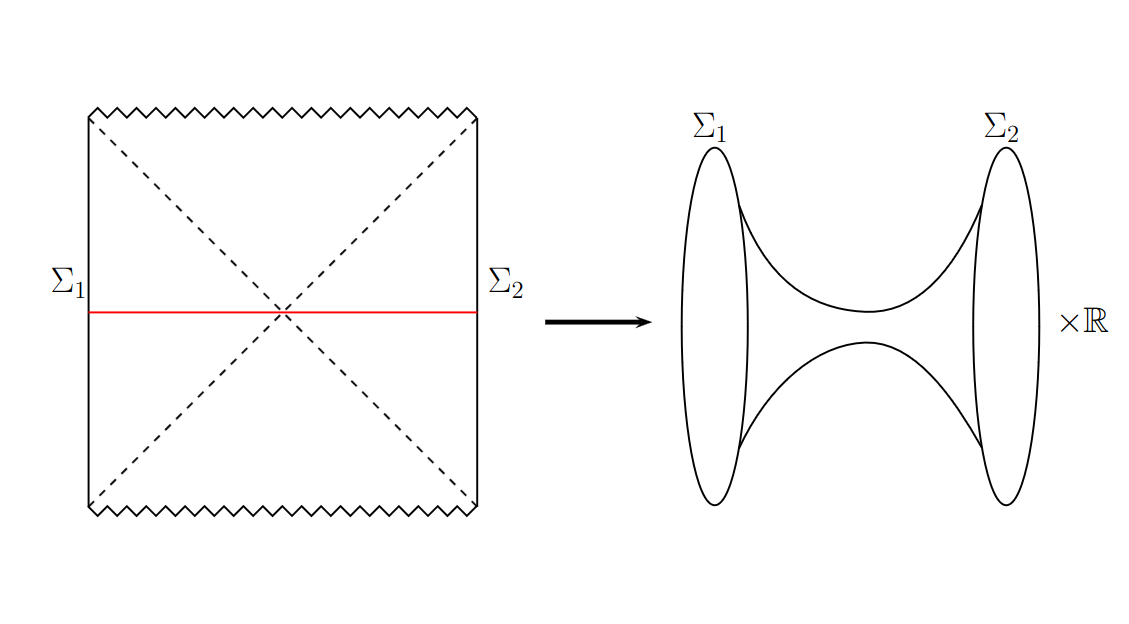
Asymptotic symmetries of three-dimensional (super)gravity
The study of asymptotic symmetries in three dimensional gravity focuses on the boundary behavior of spacetime, particularly examining the asymptotic symmetries that leave the boundary fields invariant. These symmetries play a pivotal role in the AdS/CFT correspondence, connecting a gravitational theory in AdS space to a dual conformal field theory living on the boundary. The geometric action on the coadjoint orbit of the asymptotic symmetry groups involves the symplectic structure associated with these symmetries. This approach allows for a geometric interpretation of the symmetries’ action, revealing a connection between the bulk gravitational theory and the boundary conformal field theory. This work provides insights into the relationship between the bulk and boundary theories, shedding light on fundamental aspects of quantum gravity and offering a deeper understanding of holography in the context of the AdS/CFT correspondence.
Publications related to this research project:
- Asymptotic dynamics of AdS3 gravity with two asymptotic regions, with Marc Henneaux, and Arash Ranjbar
- Geometric actions and flat space holography, with Max Riegler
- Asymptotic dynamics of three dimensional supergravity and higher spin gravity revisited, with Arash Ranjbar and Turmoli Neogi
Soft hairy black holes and near-horizon symmetry algebra
Research into black holes with soft hair focuses on understanding the near-horizon symmetries and their implications for the information loss paradox. Soft hair refers to a set of zero-energy excitations near the event horizon of black holes, which contribute to the black hole’s entropy and potentially resolve the information loss puzzle. Investigating the near horizon symmetry algebras, particularly the symmetries associated with the dynamics near the black hole’s horizon, offers a new perspective on black hole microstates and information storage. The soft hair paradigm suggests that these symmetries might encode information that would otherwise be lost due to Hawking radiation, potentially offering a resolution to the information loss paradox in black hole physics. Understanding these symmetries and their relation to the quantum structure of black holes is a promising avenue in reconciling quantum mechanics with general relativity and elucidating the fate of information that falls into black holes.
Publications related to this project:
- Soft Heisenberg hair on black holes in three dimensions with Hamid Afshar, Stephane Detournay, Daniel Grumiller, Alfredo Perez, David Tempo and Ricardo Troncoso
- Soft hairy horizons in three spacetime dimensions with Hamid Afshar, Daniel Grumiller, Alfredo Perez, David Tempo and Ricardo Troncoso
- Near horizon dynamics of three dimensional black holes with Daniel Grumiller
- Soft hairy warped black hole entropy with Philip Hacker and Daniel Grumiller


Three dimensional massive gravity and Chern-Simons-like theories of gravity
Massive gravity theories introduce massive gravitons while preserving consistent linearized dynamics of gravity, with potential implications for dark energy and dark matter. In three spacetime dimensions, adding consistent combinations of higher-derivative terms to the Einstein-Hilbert action also gives rise to a massive graviton. However, the boundary theory of positive energy bulk gravitons has negative central charge, leading to loss of unitary. We propose a generalization in a first-order formulation, leading to a set of ‘Chern-Simons-like theories of gravity’ positive bulk energy and positive boundary central charge can be achieved simultaneously. The parity-preserving generalization related to bimetric theories of gravity, while the parity-odd generalization gives an alternative to topologically massive gravity
Publications related to this research project:
- Minimal Massive 3D Gravity, with Eric Bergshoeff, Alasdair Routh and Paul Townsend
- Zwei-Dreibein Gravity: A Two-Frame-Field Model of 3D Massive Gravity, with Eric Bergshoeff, Sjoerd de Haan, Olaf Hohm and Paul Townsend
- Chern-Simons-like Gravity Theories, with Eric Bergshoeff, Olaf Hohm and Paul Townsend
- Extended massive gravity in three dimensions and Interacting spin-2 fields in three dimensions with Eric Bergshoeff and Hamid Afshar
 Wout Merbis